Accessories & Consumables
Complete accessories checklist, consumables management, and spare parts strategy for groundwater and drinking water monitoring stations — ensuring continuous operation and compliance readiness.
8.1 Accessories Checklist
The accessories checklist below provides a comprehensive reference for all items required to commission, operate, and maintain a monitoring station. Items are organized into four categories: Cables & Connectors, Mechanical Hardware, Consumables, and Tools & Documentation. Each category is color-coded in the visual checklist for easy reference during site visits and procurement.
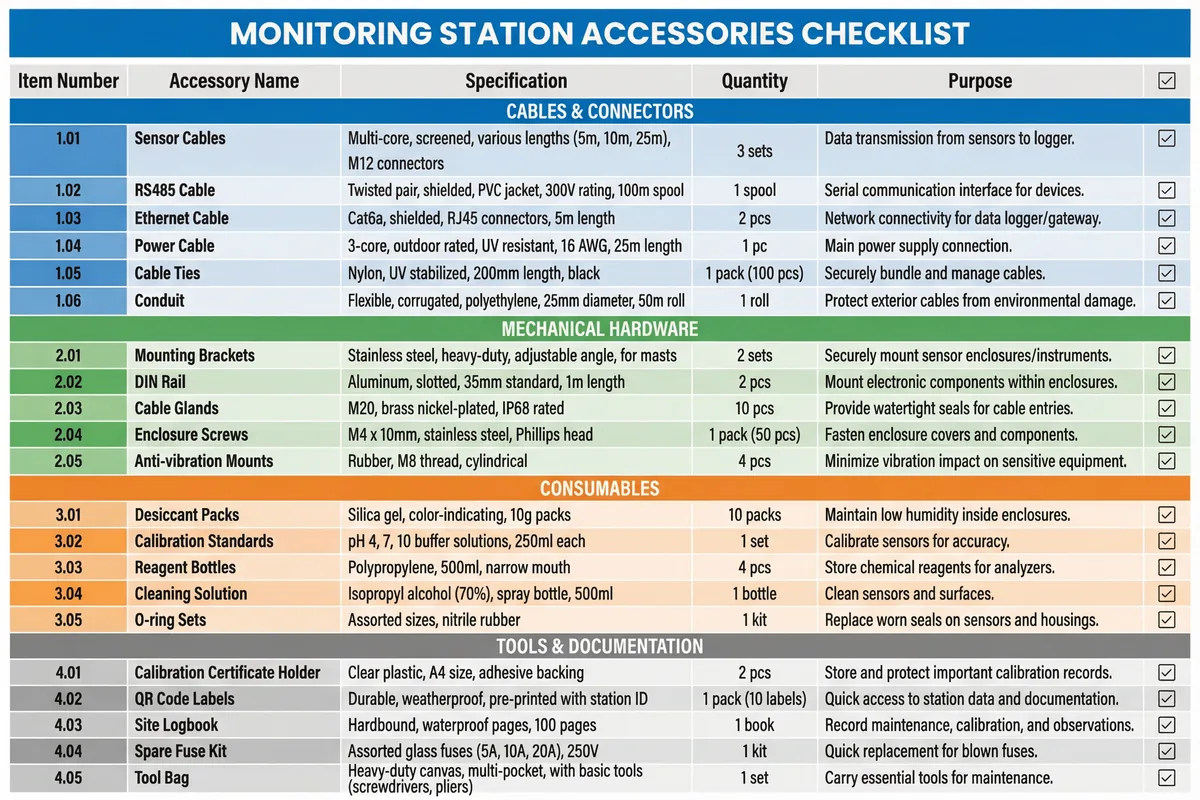
Figure 8.1: Monitoring Station Accessories Checklist — Complete Reference for Cables, Hardware, Consumables, and Tools with Specifications and Quantities
The checklist is designed to be used at three stages: during initial procurement (to ensure all items are included in the bill of materials); during pre-commissioning preparation (to verify all items are on-site before the commissioning team arrives); and during periodic maintenance visits (to verify that consumables are replenished and tools are available). Missing accessories are a leading cause of commissioning delays and incomplete maintenance visits.
8.2 Consumables Management
Consumables management is a critical but often neglected aspect of monitoring system operations. Reagent depletion, expired calibration standards, and depleted desiccant packs are among the most common causes of analyzer downtime and data quality problems. A proactive consumables management system — with automated low-stock alerts, defined reorder points, and a minimum stock level policy — prevents these avoidable failures.
| Consumable | Typical Consumption Rate | Reorder Point | Minimum Stock | Storage Requirements |
|---|---|---|---|---|
| Residual Chlorine Reagent | 1 bottle/month per analyzer | 2 bottles remaining | 3 months supply | Cool, dark, <25°C; check expiry date |
| pH Buffer Solutions | 1 set/quarter per sensor | 1 set remaining | 2 sets per sensor type | Sealed, <25°C; 12-month shelf life |
| Turbidity Standards | 1 set/6 months per analyzer | 1 set remaining | 2 sets per range | Sealed, avoid freezing; 12-month shelf life |
| Desiccant Packs | Replace when color-change indicator saturated | Visual inspection at each visit | 10 packs per station | Sealed bag until use; regenerable by heating |
| DO Membrane Caps | 1 cap/3 months per sensor | 1 cap remaining | 4 caps per sensor | Sealed, refrigerated; 12-month shelf life |
| O-ring Sets | 1 set/annual service per sensor | 1 set remaining | 2 sets per sensor model | Sealed bag, away from UV and ozone |
| Sampling Bottles | As required by sampling schedule | 1 month supply remaining | 3 months supply | Clean, sealed; pre-preserved if required |
8.3 Spare Parts Strategy
A well-designed spare parts strategy balances the cost of holding inventory against the cost of downtime when parts are unavailable. For remote monitoring stations, the cost of a technician visit to install a spare part that was not on-site can easily exceed the cost of the part itself. The spare parts strategy must account for lead times from suppliers, the criticality of each component, and the frequency of failure based on field experience.
The recommended approach classifies spare parts into three tiers. Tier 1 (On-Site Spares) includes items that fail frequently and whose absence causes immediate data loss — sensor consumables, fuses, and communication SIM cards. Tier 2 (Regional Depot Spares) includes items that fail occasionally and can be replaced within 24–48 hours — complete sensor assemblies, RTU units, and cellular routers. Tier 3 (Central Warehouse Spares) includes items that fail rarely but have long lead times — specialized analyzers, solar panels, and custom enclosures.
| Spare Part | Tier | Recommended Stock | Replacement Time | Criticality |
|---|---|---|---|---|
| Sensor cables (per type) | Tier 1 | 1 per 5 stations | Same visit | High |
| Fuse kit (assorted) | Tier 1 | 1 kit per station | Same visit | High |
| SIM card (spare) | Tier 1 | 1 per station | Same visit | High |
| Water level sensor (complete) | Tier 2 | 1 per 10 stations | 24–48 h | High |
| Multi-parameter sonde (complete) | Tier 2 | 1 per 5 stations | 24–48 h | High |
| RTU/datalogger unit | Tier 2 | 1 per 20 stations | 24–48 h | Critical |
| Cellular router | Tier 2 | 1 per 20 stations | 24–48 h | Critical |
| Solar panel (complete) | Tier 3 | 1 per 50 stations | 3–7 days | Medium |
| Residual chlorine analyzer | Tier 3 | 1 per 10 analyzers | 3–7 days | High |
8.4 Procurement Tips & Common Mistakes
Key Procurement Recommendations
- Always order accessories and consumables at the same time as core instruments — they are frequently forgotten until commissioning day
- Verify that calibration standards are traceable to national standards and include certificates of analysis
- Check reagent shelf life before ordering — ordering a 2-year supply of a reagent with a 6-month shelf life wastes money and creates disposal problems
- Standardize on a single cable connector type across all sensors at a site to reduce spare parts complexity
- Order 10% extra cable length for all sensor cables — field conditions always require more cable than the design estimate
- Include a spare set of enclosure door seals in the initial order — seals degrade over time and are frequently unavailable locally