Procurement Guide
Vendor evaluation criteria, quality comparison, specification writing guidance, and procurement process recommendations for groundwater and drinking water monitoring system equipment.
10.1 Quality Grade Comparison
Equipment quality has a profound impact on total lifecycle cost, data quality, and maintenance burden. The initial purchase price of a monitoring instrument represents only a fraction of the total cost of ownership over a 10-year operational period. Professional-grade instruments typically cost 2–4 times more than standard-grade alternatives at purchase, but deliver significantly lower maintenance costs, better data quality, and longer operational life. The comparison below illustrates the key differences between standard and professional grade water quality sensors.
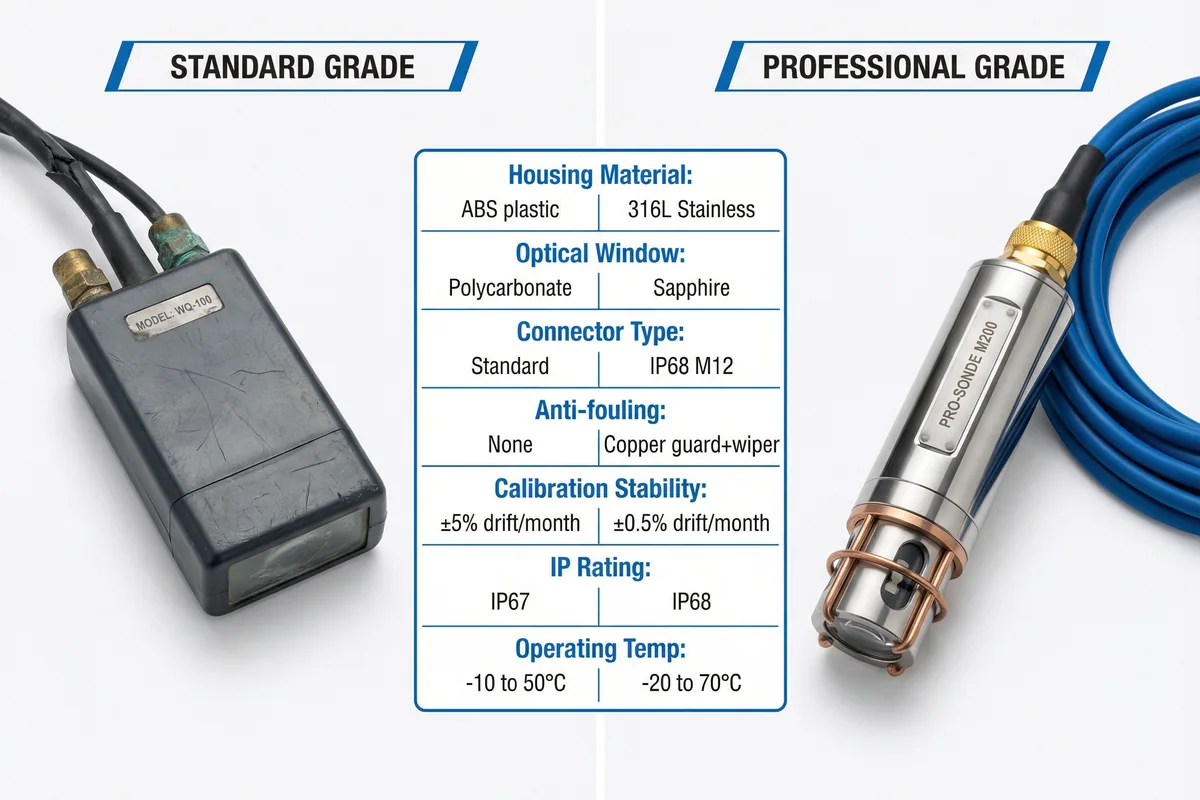
Figure 10.1: Quality Grade Comparison — Standard Grade vs. Professional Grade Water Quality Sensor, showing material, connector, anti-fouling, and calibration stability differences
The most significant quality differentiators are housing material, optical window quality, connector type, and anti-fouling capability. ABS plastic housings degrade in UV light and are susceptible to chemical attack from aggressive groundwater. Stainless steel 316L housings resist both UV and chemical attack, maintaining dimensional stability and sealing integrity over years of deployment. Sapphire optical windows resist scratching and biofouling adhesion far better than polycarbonate, maintaining optical clarity and measurement accuracy over much longer intervals between cleaning.
| Quality Dimension | Standard Grade | Professional Grade | Impact on Operations |
|---|---|---|---|
| Housing Material | ABS plastic or aluminum | 316L stainless steel or titanium | Professional grade survives 10+ years; standard may fail in 3–5 years in aggressive water |
| Optical Window | Polycarbonate (scratches easily) | Sapphire (scratch-resistant) | Professional grade maintains accuracy 3× longer between cleaning |
| Connector Type | Standard plastic connectors | IP68-rated M12 stainless connectors | Connector failure is leading cause of field faults; professional grade reduces by 80% |
| Anti-fouling | None | Copper guard + mechanical wiper | Professional grade extends calibration interval from 1 month to 3–6 months |
| Calibration Stability | ±5% drift/month | ±0.5% drift/month | Professional grade data suitable for compliance; standard grade requires frequent recalibration |
| Temperature Range | -10 to 50°C | -20 to 70°C | Professional grade operates in extreme climates without performance degradation |
| Typical Purchase Price | $200–$800 | $800–$3,500 | Professional grade typically 3–4× higher initial cost |
| 10-Year TCO | $3,000–$8,000 (maintenance-heavy) | $2,500–$6,000 (lower maintenance) | Professional grade often lower TCO despite higher purchase price |
10.2 Vendor Evaluation Framework
Vendor evaluation should go beyond product specifications to assess the vendor's ability to support the system throughout its operational life. A vendor who cannot provide timely technical support, spare parts, or calibration services creates operational risk that is not reflected in the purchase price. The evaluation framework below provides a structured approach to vendor assessment that considers both technical and commercial factors.
| Evaluation Category | Weight | Key Questions | Minimum Acceptable |
|---|---|---|---|
| Technical Performance | 30% | Does the product meet all specification requirements? Are performance claims independently verified? | All mandatory specifications met; third-party test data available |
| Product Quality & Reliability | 20% | What is the MTBF? Are there reference installations with >3 years operation? | MTBF >50,000 h; at least 3 reference sites available for inspection |
| After-Sales Support | 20% | What is the response time for technical support? Is local support available? | Technical support response <4 h; local service center within 500 km |
| Spare Parts Availability | 15% | Are spare parts available for >10 years? What are lead times? | Spare parts commitment >10 years; standard parts <2 weeks lead time |
| Software & Integration | 10% | Are open protocols (Modbus, SDI-12) supported? Is firmware updateable? | Open protocol support; firmware updates available; API documentation provided |
| Commercial Terms | 5% | What is the warranty period? Are calibration services included? | Minimum 2-year warranty; calibration services available at reasonable cost |
10.3 Specification Writing Guidance
Technical specifications for monitoring equipment procurement must be written to define minimum performance requirements without being so prescriptive that they exclude competitive alternatives or favor a specific vendor. The specification should focus on what the equipment must do (functional requirements) and how well it must do it (performance requirements), rather than how it is built (design requirements). Design requirements should only be specified when they are genuinely necessary for compatibility or safety reasons.
Specification Writing Best Practices
- State all performance requirements as measurable, testable criteria with specific pass/fail thresholds
- Specify the test method or standard that will be used to verify each performance requirement
- Include environmental requirements (temperature, humidity, IP rating) appropriate for the deployment environment
- Specify interface requirements (protocol, connector type, signal range) needed for system integration
- Require documentation: calibration certificates, test reports, installation manuals, and maintenance procedures
- Include a list of approved equivalent standards (ISO, EN, ASTM) to allow international vendors to demonstrate compliance
- Avoid brand names or model numbers in specifications; use performance requirements instead